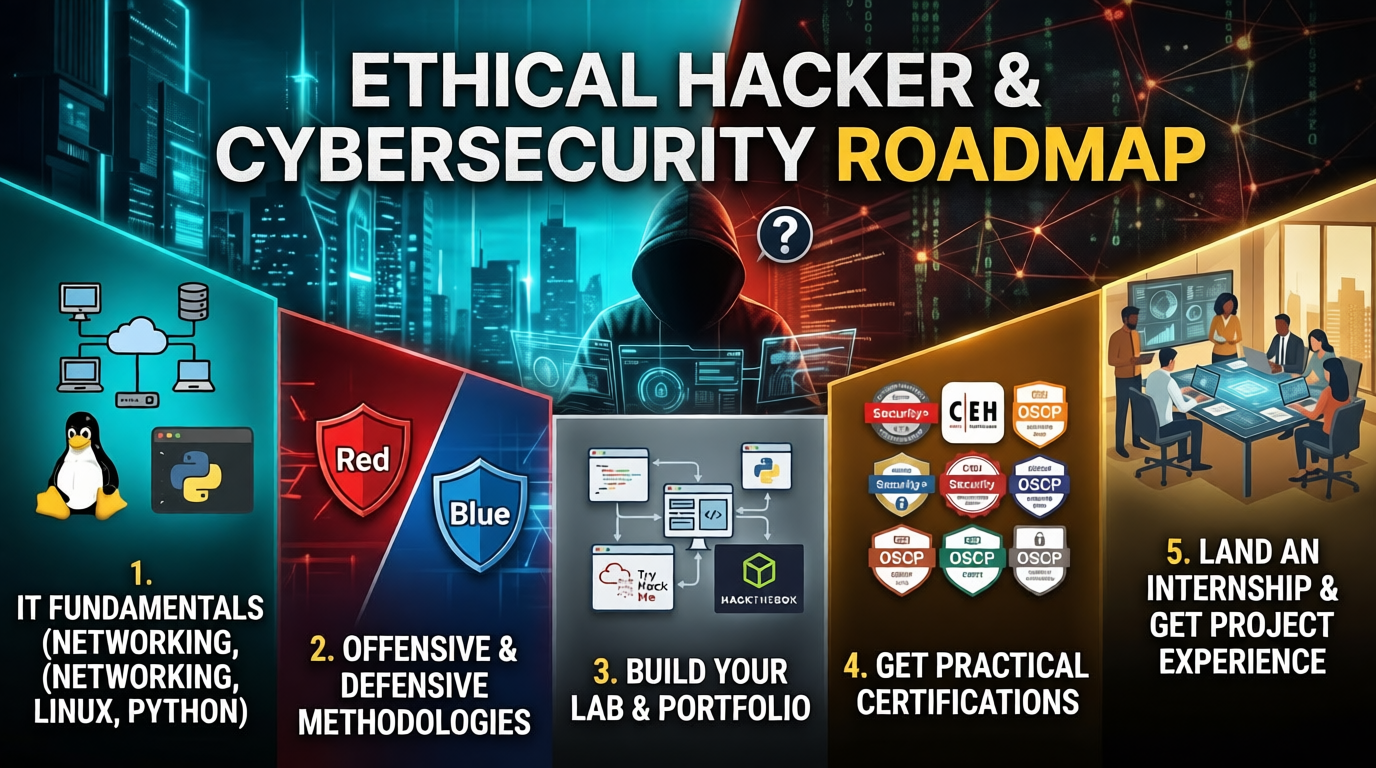
The Ultimate Ethical Hacking & Cybersecurity Career Roadmap
Cybersecurity has evolved from a niche support function to a key board-level priority. With the rapid digitization of enterprise workloads, the demand for skilled cybersecurity professionals has reached an all-time high.
However, entering the industry can be overwhelming. Aspiring ethical hackers are often met with conflicting advice about certifications, programming languages, and degrees. This guide provides a clear, practical roadmap to building a career in cybersecurity.
Phase 1: Establish the Fundamentals
You cannot protect (or break) what you do not understand. Before learning exploitation tools, you must master the fundamental building blocks of IT:
1. Networking Protocols Understand the OSI model, subnetting, DNS, DHCP, and how routers and switches route packets. You should know how to read packet captures using tools like Wireshark.
2. Linux System Administration Most servers, databases, and security appliances run on Linux. Learn file system structures, user permissions, shell commands, and bash scripting.
3. Basic Programming (Python / Bash) While you don't need to be a software architect, you must be able to read code and write simple automation scripts. Python is the industry standard for writing exploit payloads and data parsers.
Phase 2: Learn Offensive and Defensive Methodologies
Once the fundamentals are solid, you must choose (or study both) a primary track:
Offensive Track (Red Teaming / Penetration Testing) Focuses on finding vulnerabilities and exploiting them to bypass systems. Key areas to study: - OWASP Top 10 Web Vulnerabilities - Network vulnerability scanning and port mapping - Active Directory security controls - Binary analysis and exploitation
Defensive Track (Blue Teaming / SOC Analysis) Focuses on monitoring networks, detecting intrusions, and responding to security incidents. Key areas: - Security Information and Event Management (SIEM) tools like Splunk or ELK - Incident Response (IR) plans and forensics - Firewall configurations and Intrusion Detection Systems (IDS/IPS) - Log analysis across Windows Event Viewer and Linux syslog files
Phase 3: Build a Practical Lab and Portfolio
Theoretical certifications are not enough. Hiring managers want proof of your practical capabilities. Build a portfolio using these platforms:
- TryHackMe: Excellent for beginners to learn step-by-step methodologies.
- Hack The Box (HTB): More advanced, gamified boxes focusing on realistic exploit scenarios.
- PortSwigger Web Security Academy: The gold standard for web application security.
- GitHub: Document your scripts, home lab setups, and write-ups of retired boxes. This acts as your digital resume.
Phase 4: Target Key Industry Certifications
Certifications help get your resume past HR filters. Focus on certifications that require hands-on examinations rather than multiple-choice questions:
- CompTIA Security+: Best starting point to validate general security knowledge.
- Certified Ethical Hacker (CEH): Good for learning foundational terms and tools.
- Offensive Security Certified Professional (OSCP): The industry gold standard for penetration testing, requiring a 24-hour practical hacking exam.
- eLearnSecurity Certified Professional Penetration Tester (eCPPT): A highly regarded practical penetration testing certification.
Phase 5: The Value of Hands-on Internships
Many students make the mistake of collecting theoretical certifications without gaining real-world project exposure. A 3-month stipend-based internship inside an active security firm provides critical context:
You learn how to interact with real developers, write professional-grade audit reports, work within controlled scopes, and understand the difference between theoretical threat models and actual enterprise constraints.
Our 1-Year Training Program is specifically structured around this insight—combining 9 months of advanced hands-on learning with a 3-month stipend internship on active, corporate client audits. Explore the details and apply on our Training Intake Page.