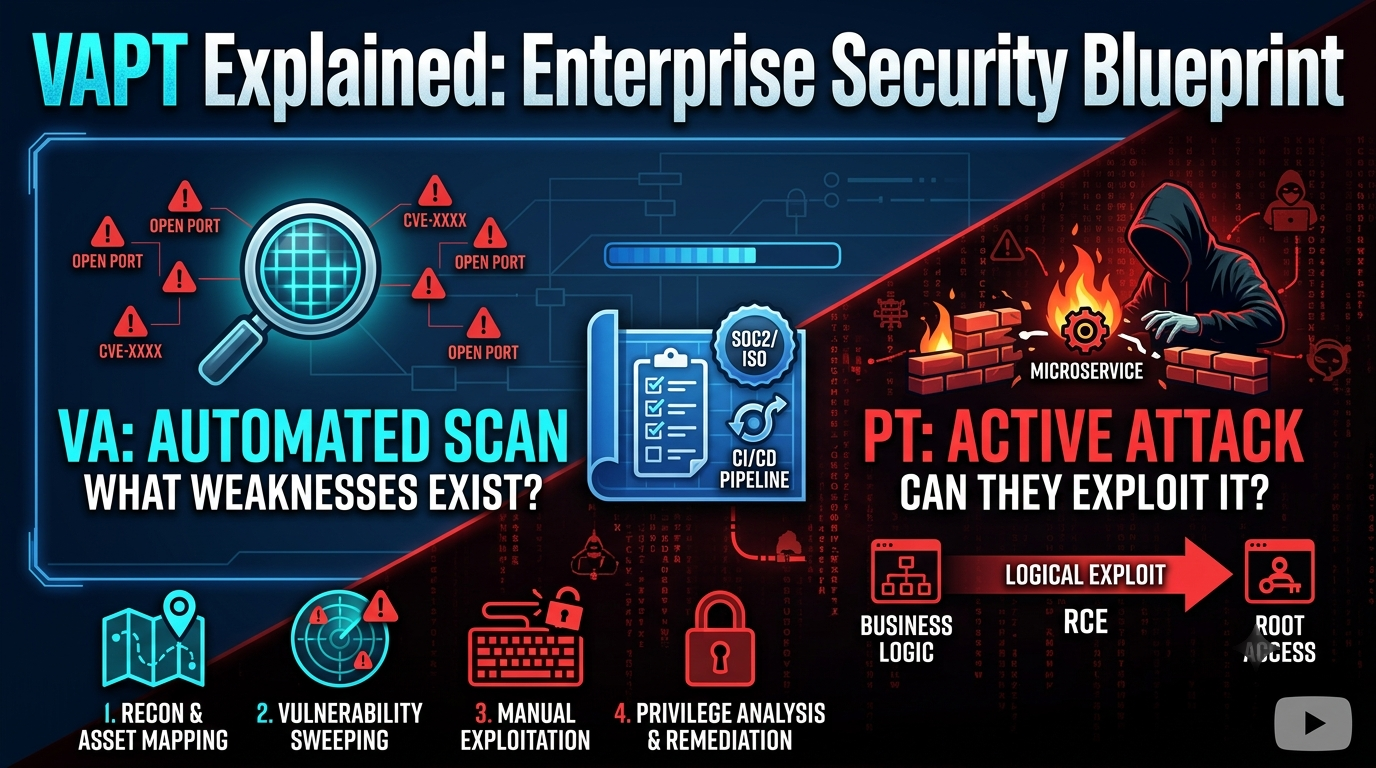
Vulnerability Assessment & Penetration Testing (VAPT): An Enterprise Security Blueprint
In the modern enterprise landscape, digital attack surfaces are expanding faster than security teams can monitor them. With cloud migrations, API integrations, and hybrid workforces, traditional perimeter defense is no longer sufficient.
This article outlines the crucial distinction between vulnerability scanning and active penetration testing, and offers a blueprint for implementing a robust VAPT program that aligns with frameworks like SOC 2, ISO 27001, and GDPR.
1. What is VAPT? Understanding the Core Components
Although frequently used as a single term, VAPT actually combines two distinct but complementary cybersecurity methodologies:
Vulnerability Assessment (VA) VA is a systematic, automated scan of network and system configurations to identify known security vulnerabilities. It answers the question: "What security weaknesses exist on our systems?"
Penetration Testing (PT) PT is an active, controlled simulation of a cyberattack. An ethical hacker attempts to bypass security controls, escalate privileges, and exploit the vulnerabilities discovered during the VA phase. It answers the question: "Can a real-world attacker exploit these weaknesses to access sensitive assets?"
| Attribute | Vulnerability Assessment (VA) | Penetration Testing (PT) |
|---|---|---|
| Mechanism | Automated sweeps using database scanners | Manual exploration and logical exploitation |
| Scope | Wide - checks all configured endpoints | Focused - target-centric attack paths |
| Output | List of vulnerabilities with severity ranks | Exploitation logs, proof-of-concepts, impact proof |
| False Positives | Common (requires manual validation) | Minimal (all findings are manually verified) |
| Frequency | Weekly/Monthly/Continuous | Annually or after major software releases |
2. Why Automated Scans Alone Fail Modern Startups
Many organizations run monthly automated scans and assume they are secure. However, automated tools struggle to detect logical vulnerability layers, which account for a massive percentage of real-world data breaches. These include:
Business Logic Flaws: An API endpoint that allows a user to modify their user ID in a request parameters to view another user's invoice (IDOR).
Privilege Escalation: Exploiting subtle configuration errors in microservice middleware to obtain administrative root tokens.
Chained Exploitation: Combining three "low-severity" alerts to achieve complete remote code execution (RCE).
Only manual, human-led penetration testing by certified ethical hackers can locate these highly critical, logical paths.
3. The 5-Phase VAPT Blueprint
To ensure maximum security return on investment, Cyber Crews implements a structured, threat-modeled auditing lifecycle:
- Reconnaissance & Asset Mapping: Collecting public threat intelligence, DNS mapping, and mapping active subdomains.
- Vulnerability Sweeping: Running authenticated and unauthenticated scans to map logical attack surfaces.
- Manual Exploitation: Safely exploiting SQL injections, cross-site scripting (XSS), insecure direct object references, and broken authentication controls.
- Privilege Analysis: Checking local configs, kernel versions, and database authorization boundaries to see if a standard user can obtain super-admin control.
- Remediation & Re-testing: Providing developers with exact remediation instructions and verification codes, followed by a validation scan to confirm fixes are successful.
4. Key Benefits of a Structured VAPT Auditing Cycle
- Preempt Exploits: Neutralize vulnerabilities before external threats exploit them.
- Ensure Compliance: Meet strict requirements for SOC 2 Type II, ISO 27001, HIPAA, and PCI-DSS audits.
- Safeguard Brand Trust: Show enterprise clients that security is treated with institutional priority.
- Verify Code Integrity: Integrate automated scans into your CI/CD pipelines to catch vulnerabilities before code is pushed to production.
To discuss how to scope a threat-modeled security audit for your organization, request a consultation on our Contact Page.