Dark Web Monitoring: Turning Threat Intelligence into Early Breach Detection
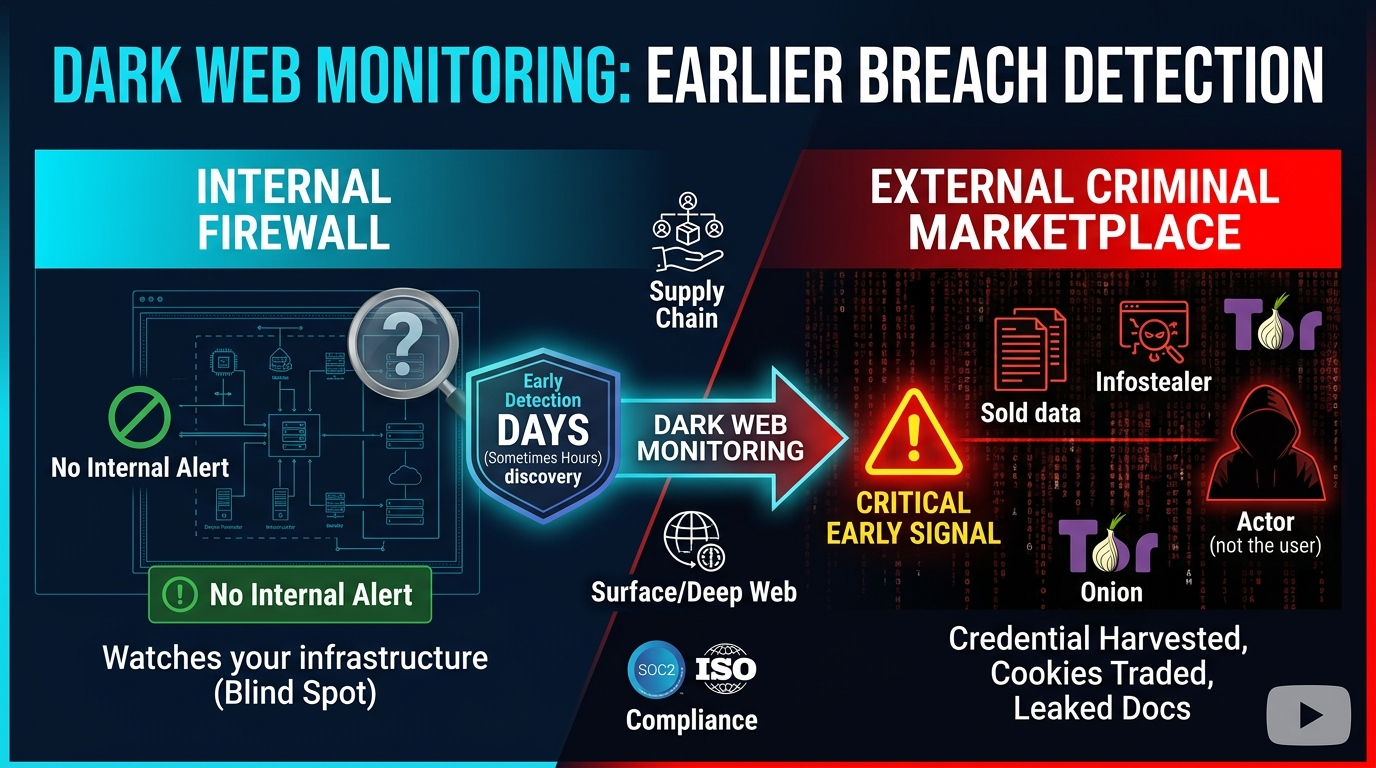
For most organizations, the first sign of a data breach isn't an internal alert — it's a customer, a journalist, or a regulator asking why their credentials showed up for sale online. By the time that conversation happens, the damage is already done.
Cyber Threat Intelligence (CTI), and dark web monitoring in particular, exists to close that gap. Done well, it shifts breach discovery from months after the fact to days — sometimes hours.
1. Why "We'll Find Out From Our Firewall" No Longer Works
Traditional security monitoring watches your own perimeter: firewalls, endpoints, network traffic. That's necessary, but it has a blind spot — it only sees attacks against infrastructure you control.
Modern breaches increasingly originate outside that perimeter entirely:
- Employee credentials harvested by infostealer malware on a personal device
- Session cookies and API tokens traded on criminal marketplaces
- Leaked source code or internal documents surfacing on paste sites
- Look-alike domains being staged for phishing campaigns before a single email is sent
None of this triggers an internal alert. The organization is often the last to know.
2. What Dark Web Monitoring Actually Covers
"Dark web monitoring" is often used as a catch-all, but a mature CTI program spans three distinct layers:
Dark web — Tor-based marketplaces and forums where stolen credentials, access to corporate networks ("initial access broker" listings), and breached databases are bought and sold.
Deep web — Non-indexed but not necessarily illicit sources: private forums, invite-only Telegram and Discord channels, and closed hacking communities where tooling and techniques circulate before they hit the mainstream.
Surface web — Publicly indexed but easily missed sources: paste sites, misconfigured public repositories, exposed cloud storage buckets, and social media chatter referencing a target organization.
An effective program monitors all three, correlating signals rather than treating each as an isolated alert.
3. From Signal to Action: What Good CTI Looks Like
Raw data isn't intelligence. A feed listing every mention of your company name is noise, not insight. The value comes from context and prioritization:
- Attribution — Is this a known threat actor or group, and what is their typical playbook?
- Relevance — Does this credential belong to a current employee, and does it work against a live system?
- Timing — Is this a stale breach from 2019 recirculating, or fresh compromise?
- Actionability — Can this be turned into an immediate response — forced password reset, session revocation, domain takedown — within hours?
This is the difference between a threat intelligence feed and a threat intelligence program.
4. Where This Fits Alongside VAPT
Dark web monitoring and penetration testing answer different questions, and enterprises need both:
| Penetration Testing (VAPT) | Dark Web Monitoring / CTI | |
|---|---|---|
| Question answered | "What can an attacker exploit in our systems?" | "Has an attacker already gained a foothold or leaked our data?" |
| Vantage point | Inside-out (testing your own assets) | Outside-in (monitoring the attacker's environment) |
| Cadence | Point-in-time or periodic | Continuous |
| Primary output | Remediated vulnerabilities | Early warning and incident response triggers |
A VAPT engagement can tell you your VPN gateway is exploitable. CTI can tell you that credentials for that same VPN are already being sold. Neither replaces the other — together, they close the loop between prevention and detection.
5. Building a Practical Monitoring Program
For organizations starting out, a phased approach works better than trying to monitor everything at once:
- Define your monitoring scope — corporate domains, executive names, brand terms, known third-party vendors, and critical asset identifiers.
- Establish credential exposure baselines — understand what's already circulating from historical breaches before treating new hits as novel incidents.
- Set response playbooks in advance — who gets notified, what gets rotated, and within what timeframe, before an alert ever fires.
- Extend to the supply chain — a growing share of breaches originate through third-party and vendor compromise, not direct attacks.
- Review and tune quarterly — false positive rates and source relevance shift as threat actor behavior evolves.
6. Compliance Relevance
For organizations working toward SOC 2, ISO 27001, or similar frameworks, continuous threat intelligence increasingly maps directly to control requirements around threat detection, incident response readiness, and third-party risk monitoring — making it not just a security best practice, but part of the audit narrative.
Closing Thoughts
Attackers don't wait for your next scheduled security review. Credentials get harvested, sold, and used within days — often before an internal team has any reason to look. Dark web monitoring doesn't prevent every breach, but it collapses the time between compromise and discovery, which is frequently the single biggest factor in how much damage a breach actually causes.
If your organization doesn't yet know what's already circulating about it in criminal marketplaces, that's usually the right place to start.